

Cookies & Privacy
This website uses cookies or similar techonoglies to enhance your browsing experience and provide personalized recommendations. By contrinuing to use our website, you agree... Cookie Policy
May 19, 2018 Posted by Christa Lesté-Lasserre, MA
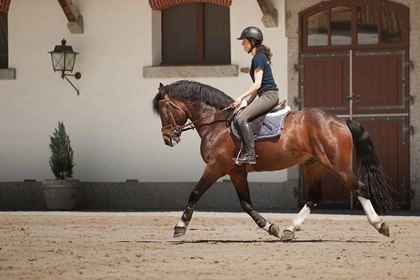
Horseback riding requires healthy backs–not just for horses but also humans. In fact, human back health can have direct implications on equine back health, as well as the horse’s welfare and performance.
That’s why French scientists recently evaluated how riders of different experience levels used their spines during riding.
They found significant differences that should influence the way coaches train and doctors treat, for the benefit of all backs involved.
The recent study results will allow trainers to help riders evolve safely in their discipline without harming their spinal columns, said Patrick Dubrulle, DC, sports physical therapist and chiropractor in the Functional Reeducation Clinic, in Beutin, France.
“By knowing the ‘spinal behavior’ of their students according to their levels, coaches can adapt their teaching so as to make it more pertinent, leading to better outcomes for both rider and horse as this ‘customized’ pedagogy will consequently result in better respect for the horse via more harmonized riding and better use of aids,” he said. Dubrulle presented his team’s research during the 2017 French Equine Research Day, in Paris.
In their study, Dubrulle and his fellow researchers investigated 47 riders’ spinal movements and angles as they rode a simulator horse.
The three categories of riders included:
novice(little to no riding experience);
intermediate (having lessons about twice a week for several years); and expert (competing at national level, riding several times a day). The riders chose their own saddles and stirrup lengths.
The researchers placed sensors at four positions on the riders’ spines: the cervical (neck) vertebrae (C4), the thoracic (rib cage) vertebrae (T1), the lumbar (lower back) vertebrae (T12), and the sacral (seat area) vertebrae (L5).
They identified fixed points on riders’ backs—regions where movement gets blocked—that vary according to experience level. Specifically, they noted that:
Based on those findings, the researchers recommended coaches and physical therapists target specific areas based on riders’ ability levels:
Work to increased pelvic mobility in novice riders; “Free up the legs” in intermediate riders; and Lighten up expert riders’ upper backs around the scapulae to give more finesse to hand movements affecting the horse’s mouth.
“Our study allows us to confirm the absolutely necessity of differentiating all the interventions regarding the rider, from medical, pedagogical, athletic, and equine health and welfare points of view,” Dubrulle said.
Julien Gouz, director of Société Kinestesia in Verton, France, and Christian Roquet, equestrian studies director of Ecoles Militaires Saint Cyr Coëtquidan in Guers, France, collaborated in the study.
Source: The Horse.
This website uses cookies or similar techonoglies to enhance your browsing experience and provide personalized recommendations. By contrinuing to use our website, you agree... Cookie Policy