

Cookies & Privacy
This website uses cookies or similar techonoglies to enhance your browsing experience and provide personalized recommendations. By contrinuing to use our website, you agree... Cookie Policy
August 1, 2007. Posted by Catherine Kohn, VMD
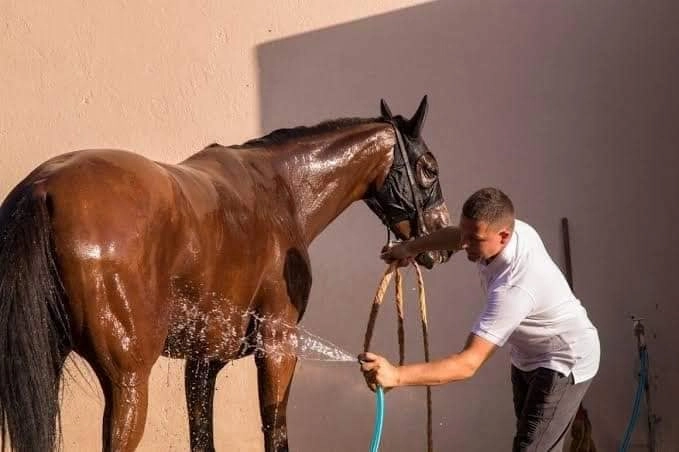
During hot weather, heat dissipation is primarily dependent on evaporation of sweat on the skin surface. Horses are capable of producing large quantities of sweat—sweating rates of 10-15 liters/hour¹,² have been reported during exercise in hot conditions. Sweat evaporates efficiently in hot, dry conditions, but not in hot, humid climates that are likely to impose a particularly large heat load because heat dissipation is compromised, and the horse retains heat. In addition, horses have a large muscle mass and a comparatively small body surface area. This configuration results in a limited surface area for evaporative heat loss.
Lethargy, unwillingness to perform as expected, a persistently high rectal temperature, and moderate to severe dehydration might be observed in overheated horses. They are usually disinterested in the environment, and they might not voluntarily eat or drink. More severe heat stress is associated with exhaustion, increasing body temperature, decreasing blood pressure, and collapse. Heat stress has deleterious effects on many organs and can be life-threatening.
During hot weather, heat dissipation is primarily dependent on evaporation of sweat on the skin surface. Horses are capable of producing large quantities of sweat–sweating rates of 10-15 liters/hour³,4 have been reported during exercise in hot conditions. Sweat evaporates efficiently in hot, dry conditions, but not in hot, humid climates that are likely to impose a particularly large heat load because heat dissipation is compromised and the horse retains (stores) heat. In addition, horses have a large muscle mass and a comparatively small body surface area. This configuration results in a limited surface area for evaporative heat loss.
Sweating requires diversion of blood to the skin, and this portion of the circulating blood volume is not available to supply oxygen to or remove metabolic wastes from working muscle. Thermoregulatory demands, therefore, compete with the demands of working muscle and might limit performance. A large volume of body water–as well as significant quantities of the important electrolytes sodium, potassium, and chloride–are lost in sweat. If fluid and electrolyte losses are extensive and are not replaced expediently, the thermoregulatory response to exercise will be compromised, and heat storage might increase to a dangerous level.
The respiratory system plays an important role in heat dissipation, accounting for loss of more than 25% of the metabolic heat load in one study of horses exercising on a treadmill¹. Increased respiratory heat loss might be associated with an increased resting respiratory rate; a twofold to threefold increase in resting respiratory rates was observed in horses during heat acclimation².
Horses vary in their ability to respond to a heat load. In general, “hot-blooded” types of horses (such as Thoroughbreds and Arabians) might be better able to dissipate heat than warm- and cold-blooded horses. The latter tend to have a larger body mass, a thicker hair coat, and a smaller body surface to mass ratio than horses of hot-blooded ancestry.
The Source: The Horse
This website uses cookies or similar techonoglies to enhance your browsing experience and provide personalized recommendations. By contrinuing to use our website, you agree... Cookie Policy