
Cookies & Privacy
This website uses cookies or similar techonoglies to enhance your browsing experience and provide personalized recommendations. By contrinuing to use our website, you agree... Cookie Policy
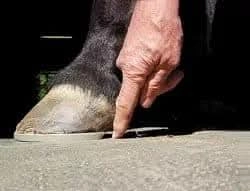
How can you make sure your horse farrier is doing a good job on your horse's hooves? Read our simple tips to learn about what your farrier does, and if he's doing it right.
By Equisearch | March 20, 2017 |
How can we tell if the farrier who trims our horses is doing a good job or not? Did your farrier check everything on your horse’s hooves? You’re not trained as a farrier specialist, so how can you be sure that your farrier is address everything on your horse? You may not be trained in the art of shoeing horses, but there are things you can look for.
Farrier and Horseman
An expensive truck with fancy lettering on the doors doesn’t guarantee that a farrier is good.
There was a horseshoer who used to trim horses wearing gray polyester pants and white suede shoes. He hopped out of an unmarked truck with a hoof knife, a pair of nippers and a rasp in his hand. Looking every bit not the part, he commenced to trim one horse after another and never got a speck of dirt on those shiny trousers or a smudge on his white bucks. He didn’t look like The Village Smithy, but he had horse sense, know-how, and an easiness about him that kept the horses calm.
A farrier should approach a horse like a horseman, with quiet confidence. That’s one of the first indications you might have the right person. Be wary of the farrier who, the first time he picks up your horse’s feet, starts criticizing work done by the previous farrier. This could be an attempt to make himself look good.
Trimming a horse is a little art, but a lot of science. While horse shoeing hasn’t changed much for hundreds of years, there are improvements being made all the time. Clue number two that you have the right guy is a farrier who keeps up with the advancements in his trade. Books, seminars, short courses, association newsletters, etc., are available. Plus, there is enough continuing education to keep any serious farrier up on the latest findings and research. However, you don’t want someone who is ready and willing to go along with every new fad or trend, or to sell you on the idea that your horse needs something extra special in the way of shoes, or wedges, or pads, and the like.
There is little regulation of the trade and almost no testing of competence, outside of what is done by organizations that certify their member farriers. Anyone can take a weekend course, buy a few tools, and stick a flier on the wall of the local tack shop. But that doesn’t make him or her a competent farrer.
On the Level
An ideal hoof trim is one that leaves the foot balanced and level. The bottom of the hoof is parallel to the coronet band. Both heels are the same height. The distance from the center of the frog to the wall is the same on both sides. The angle of the hoof is in line with the angle of the pastern, and that is the same angle as the shoulder. All of this is in a perfect world.
But sometimes our perfect horse does not have perfect feet. So if the way your blacksmith trims your horse doesn’t fit into that neat description, ask why. There can be a valid reason. He or she should be willing to answer your questions and explain why he is trimming your horse the way he is. Don’t accept a vague, “I had to do some corrective work.” Ask what the problem was and what was done to “correct” it. Your farrier should level with you, not evade your questions.
If the Shoe Fits
A well trimmed, level foot should sit on a smooth, level shoe.
If your horse is being shod, the surface of the shoe and the bottom of the hoof should meet perfectly. No gaps, unless there were some chunks missing from the hoof wall. The shoe might be handmade, or a ready-made “keg shoe.” It doesn’t matter. Being fitted properly to the foot is what matters.
The shoe should be shaped to fit the white line (the perimeter between the sole and the inside edge of the hoof wall), not the outer edge of the hoof wall.
You will likely see your farrier nail on a shoe, then rasp off the overhanging hoof wall in what might look to some people as an effort to shape the foot to fit the shoe. That’s usually not the case. A good farrier fits the shoe to the shape of the white line and any excess wall hanging over is then rasped off with no harm.
Nailing is the scariest part of shoeing to the untrained owner’s eye. But it doesn’t hurt the horse. At least it shouldn’t. And there are things you can look for.
A well-driven nail should come out of the wall exactly where the farrier intended it to come out. In normal situations, the nails should pop out pretty much in a straight line and not come out of the wall too low. No lower than a half inch above the shoe is something you can look for. Low nails are not good as they usually take some hoof wall with them if the shoe comes off.
If your horse has pieces missing from the wall to begin with, it might not be possible to have all of the nails line up, but they should be at least a half-inch up from the shoe and reasonably straight. Also look for clinches that are pulled straight down and are not pointing this way and that. The clinches should be flush with the hoof wall.
Many master farriers agree that one of the most common errors in horse shoeing is shoes that are too short, with the heel of the shoe too far forward…referred to as “short shoeing.” Here is the guideline for judging this. (Even the untrained eye can learn to see it pretty easily):
Square up the horse on a level surface. If you drop a plumb line down the center of the side of the horse’s leg, the bottom of the plumb line should fall just behind the heel of the shoe. If you look straight down the back of your horse’s leg, you should see a tiny, shiny rim of shoe showing where it curves around at the heels.
SOURCE: Equisearch.
This website uses cookies or similar techonoglies to enhance your browsing experience and provide personalized recommendations. By contrinuing to use our website, you agree... Cookie Policy