

Cookies & Privacy
This website uses cookies or similar techonoglies to enhance your browsing experience and provide personalized recommendations. By contrinuing to use our website, you agree... Cookie Policy
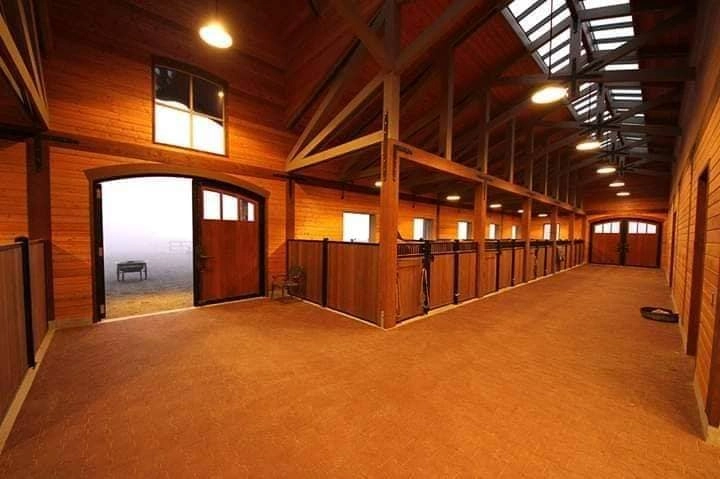
We get a lot of questions about horse stables. To give answers to the most common questions, we put together a list of important things about horse stables.
Here are the key points you can use if you are thinking about building a safe horse stable for your horse. We’ll cover the following important points that you should consider while planning a horse stable.
To begin with, when building stalls, you can choose between box (loose) stalls and tie (standing) stalls. With box stalls for an average size riding horse, the minimum measurements of the stall should be at least 3×3 meters to 3.6×3.6 meters. This is only the minimum standard, and it is recommended that you build a bigger stall if possible. These measurements of horse stables have been set by the Canadian Agri-Food Research Council, Recommended Code of Practice for The Care and Handling of Farm Animals. With tie stalls, the minimum measurements are 1.5 meters wide and 2.4 meters long. The stall should be wide enough so the horse can lie down comfortably.
Furthermore, considering the height of the stalls, a horse stall should be made from sturdy timber with walls up to 1.4 meters high. It is recommended to use a mesh on top of the wooden walls to help with ventilation and light. This also allows horses to see each other. Windows also provide natural lighting and ventilation. Try to use as many windows in a stable design as possible. To keep the horses from breaking the glass, the windows should be covered with a strong mesh. Windows that swing open are preferred over sliders because the latter might fill with dirt and start getting stuck, making them uncomfortable to use.
The aisles between stalls should be at least 3 meters wide. Since there generally is a manger for hay in front of the tie stall, the width of the manager should be taken into account while planning the stall. The horse stall should have a strong structure to tie to. The structure must also keep in mind that the horse cannot step over the tie rope but can still reach food and water.

When planning horse stables, you can choose either sliding or swinging doors for the horse stalls. The criteria for the doors are that they should be at least 1.2 meters wide, and the latches should undo easily, but not so easily that the horses can open the doors themselves. The doors to the grain room should be locked.
There are many different flooring types available for stables. Concrete is the most commonly used flooring in horse stables. Since concrete or stone floors do not drain naturally, you should either place drains in the stalls or at least avoid ammonia buildup by keeping the stalls well-cleaned. Even though hard flooring like concrete is easier to clean, many people choose to use rubber-like materials for the flooring to increase the comfort of their horses. The easiest flooring is just to leave the earth floor, which can be warmer and quieter, but also more difficult to clean.
The next step is to plan the ceilings of the horse stables. The ceilings should be high enough to allow the horse to raise its head comfortably. While 2.4 meters is the standard height for stables for small horses, taller horses need higher ceilings. It’s also possible to modify an older barn by either raising the ceiling or lowering the floor, but this may prove to be a more expensive solution. The ceilings should also be checked for safety so that there are no protruding nails from the first-floor flooring that might accidentally hurt your horse’s head.
Last but not least, the lighting and wiring of horse stables should be made safe for the horses. Lighting should be placed so that there is a minimum of dark areas. Light bulbs and switches should be placed out of reach from the horses, and the bulbs should also be surrounded by safety cages. All plug-ins should be moisture and rodent-proof.
Source: Palmatin.
This website uses cookies or similar techonoglies to enhance your browsing experience and provide personalized recommendations. By contrinuing to use our website, you agree... Cookie Policy